


[smart_track_player url=”http://traffic.libsyn.com/nionradio/175_-_Nion_Radio_-_Benjamin_Shine.mp3″ title=”Using Unconventional Tools For Art” artist=”Benjamin Shine” image=”https://nionlife.com/wp-content/uploads/2019/11/175_NIONradio_BenjamineShine_CVR-1.jpg” color=”#de4b9b” ]
“It’s a material that is half not there and I find that fascinating.”
Hey everybody, welcome back to ONKEN RADIO (formerly NION Radio), the podcast where we explore the body, mind, and soul of the creative entrepreneur. It’s my goal to help you take your creativity, business, and life to the next level. I’m so glad you’re joining me on this journey!
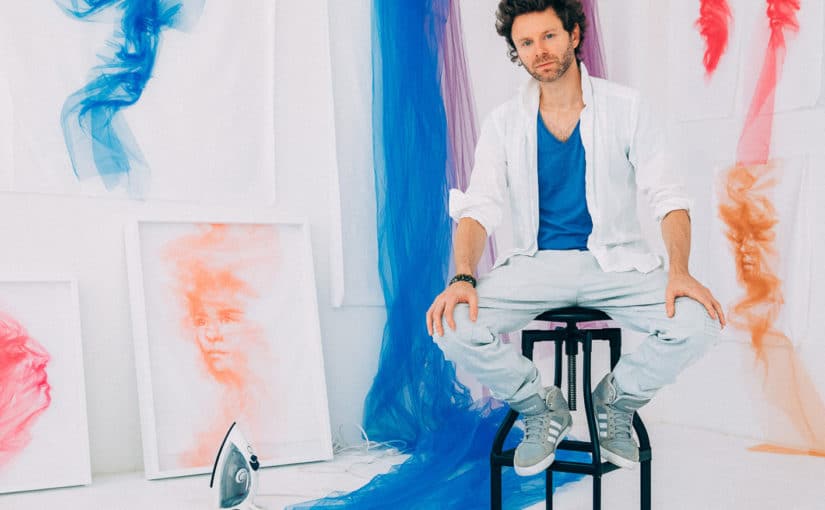
For today’s episode, I talked with artist Benjamin Shine — he may not seem like a tutu guy, but he has a background in women’s wear and makes fantastic art with single pieces of tulle fabric. In addition to tulle, Benjamin uses other unconventional materials and tools, such as irons and fence metal, to make some stunning pieces.
Finding clarity from chaos, Benjamin Shine reached success in the art world by using gravity and the density of material to create form rather than still images. I brought Benjamin on the show today to talk about the pivot from his fashion career, his graveyard of old iron, his spiritual journey with art, and so much more.
Benjamin Shine is the perfect example of a Creative Alchemist — by using unconventional tools, excellent business strategy, and tying it all back to his spiritual experiences, he has made a career in the art world that truly stands out from the rest.
Without further ado, let’s dive into the interview.
Who Is Benjamin Shine?
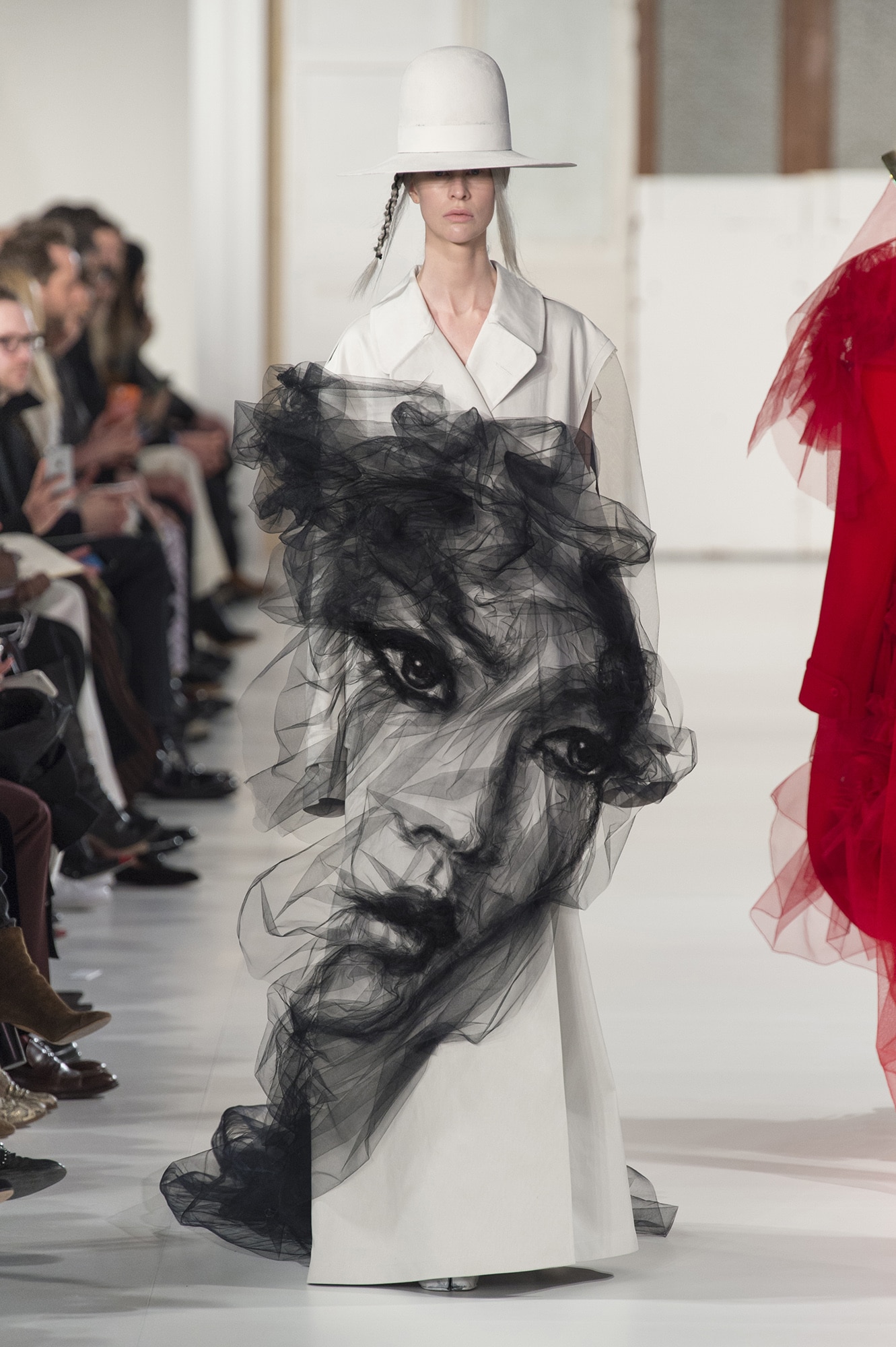
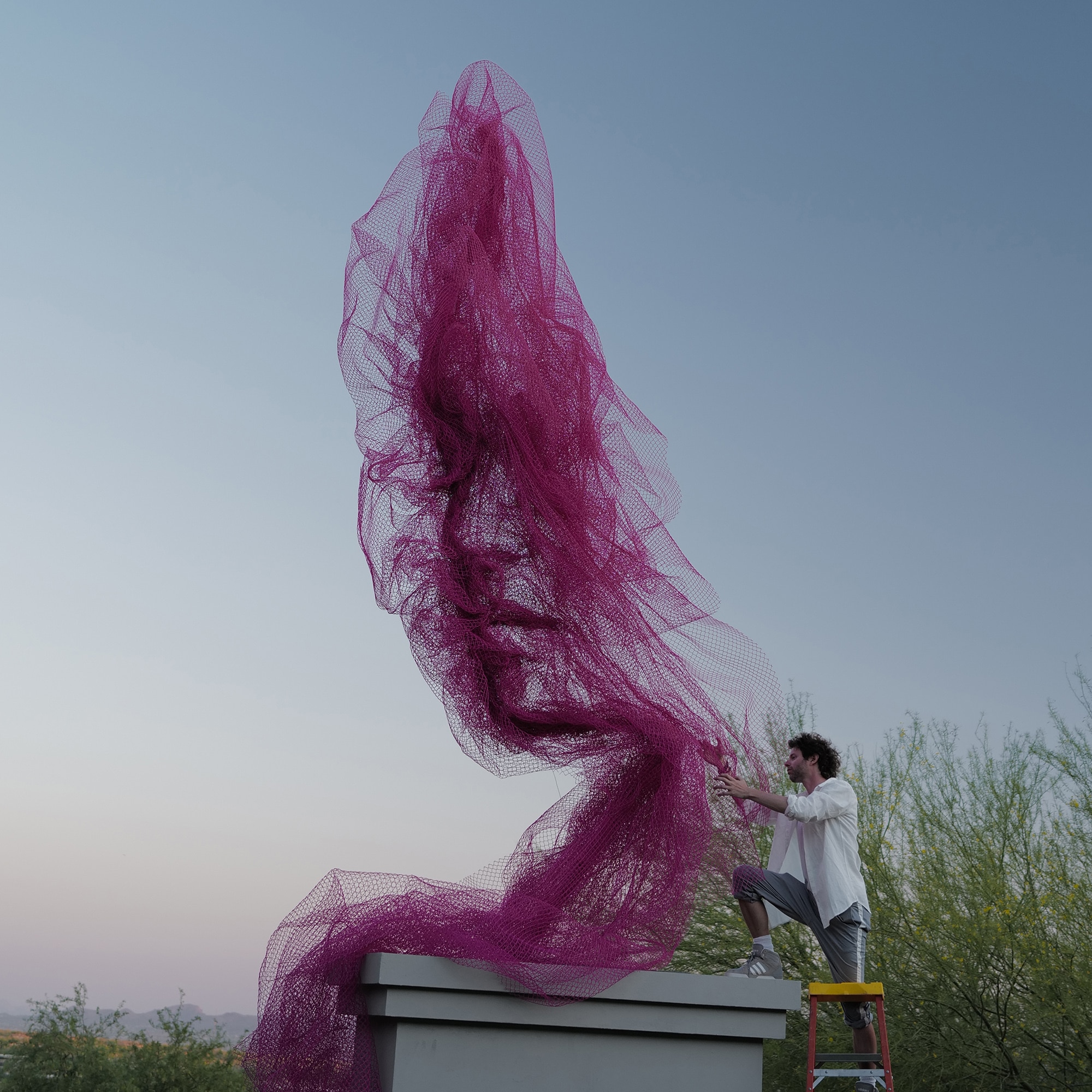
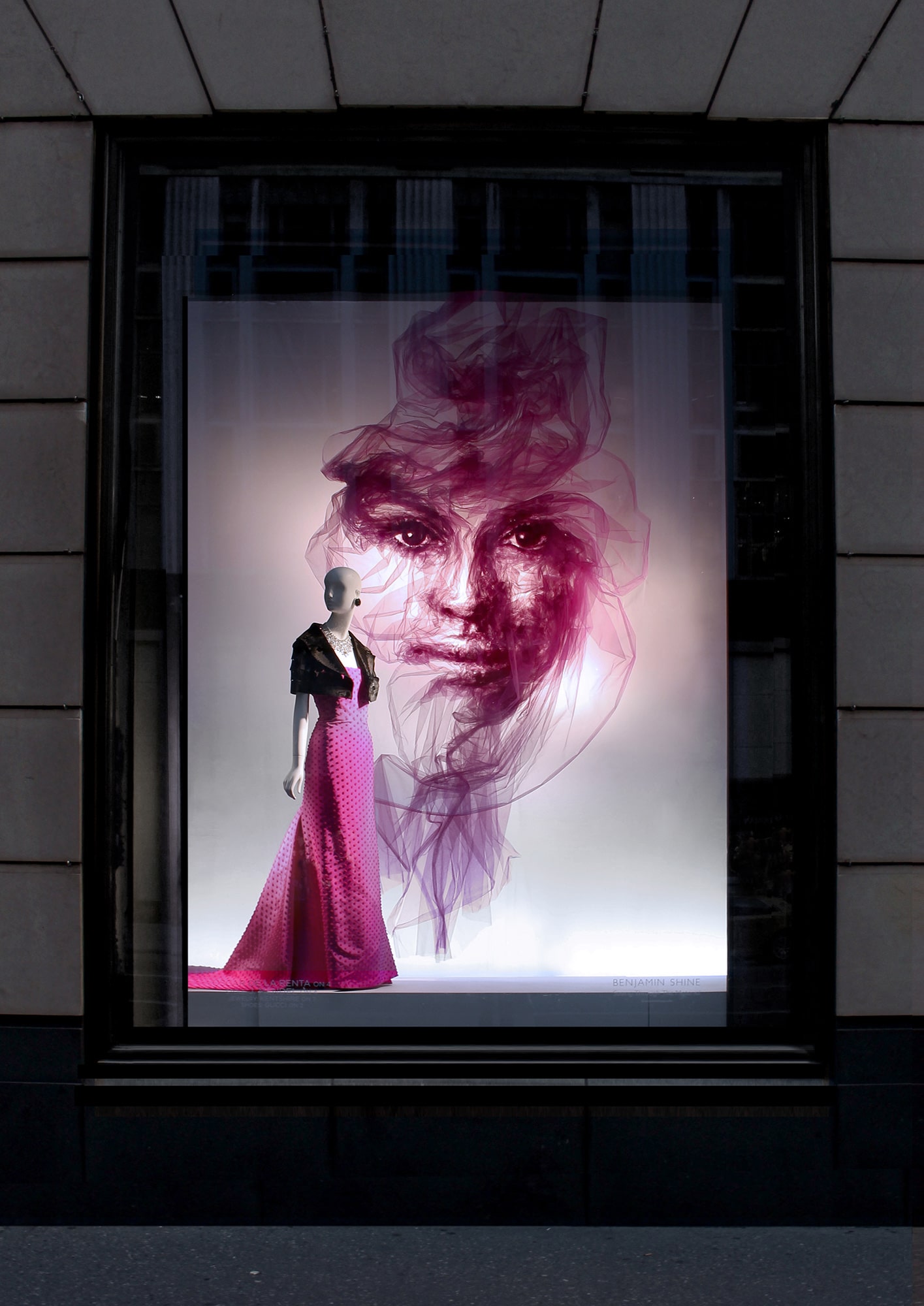
Benjamin Shine is a multidisciplinary artist who is most known for his work using tulle, which centers on ideas of energy, impermanence, and the relationship between the spiritual and the superficial. In addition to having several of his works displayed around the world, Benjamin has collaborated with several celebrities and famous designers, including John Galliano.
After being encouraged to leave fashion school in his third year, Benjamin focused his efforts on creating two items of clothing from a single piece of fabric before going down the inventor-designer rabbit hole. Now, he’s creating revolutionary tulle portraits. If you haven’t seen his work, you need to go over to his Instagram right now @benjaminshinestudio. His work with tulle is absolutely breathtaking.
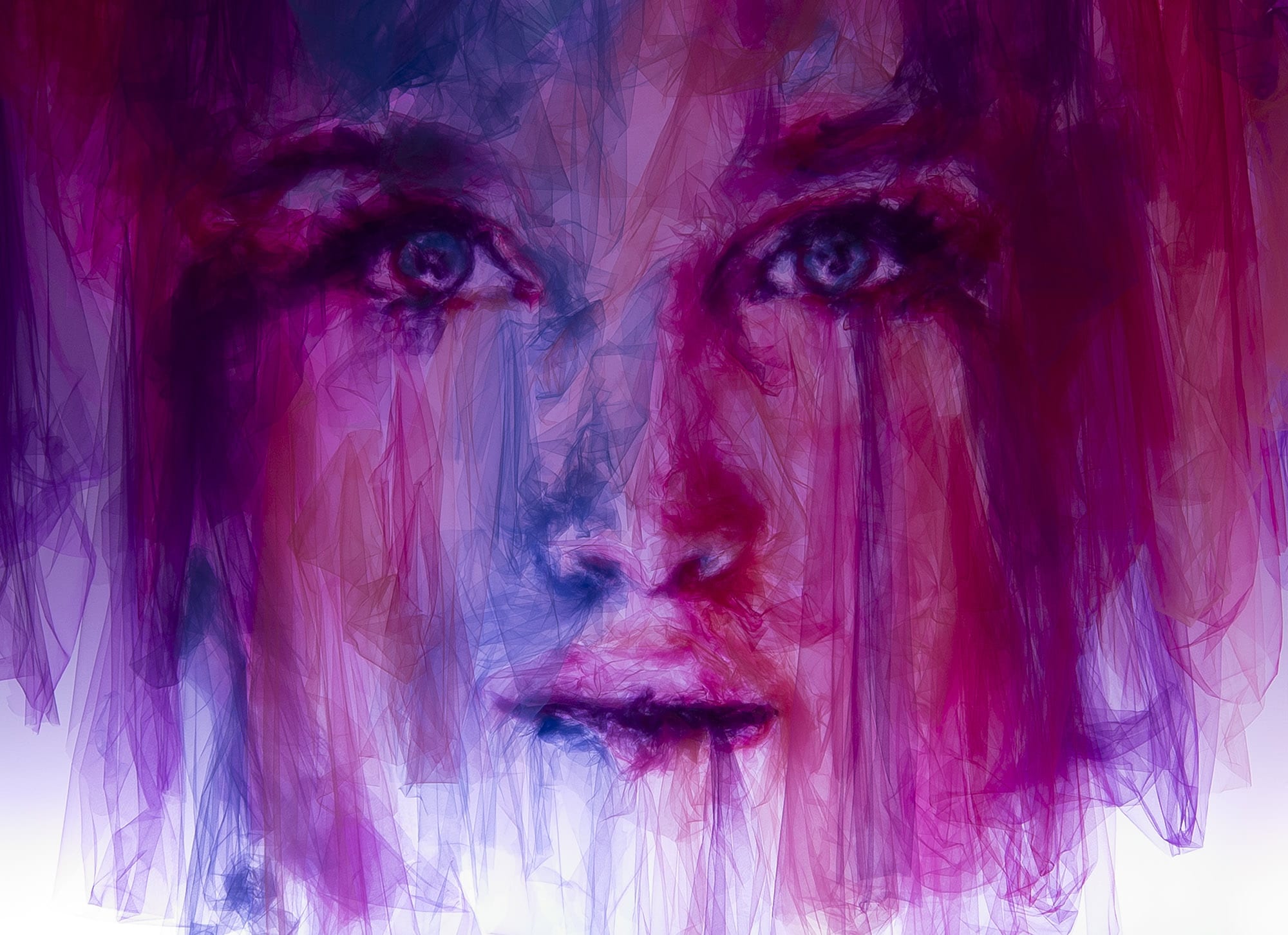
He has an amazing technique where he uses an iron and creates depth and shadows by fusing pieces of the tulle together onto a canvas. If you check out his Instagram, you can watch videos of this technique in more detail!
I met Benjamin’s wife, Danielle Shine, at an event a couple of months ago — she’s an amazing nutritionist, chef, and human being, and she connected me with her husband so I could interview him on the podcast. We talk about so much today, so make sure to listen to the full episode to get all the details. With that, let’s get started.
Pivoting From Fashion to Investor Design to Fabric Portraits
As I said above, Benjamin began his artistic career in fashion. He attended two universities — one in the U.K. and the other at St. Martins — and he specialized in women’s wear. At the time, he didn’t really know anything about fashion besides a tiny bit of work experience from when he was sixteen.
“When I got there, I sort of discovered that I really knew very little. … All these other students … knew all the designers. I really didn’t know how to serve. So I was starting right at the bottom. But I picked it up pretty quickly and I just loved working with fabric, which was a totally new medium. … I was like the art kid [who] was good at drawing and painting, but we were never taught to venture outside that … so it was a whole new medium.” – Benjamin Shine
After designing some t-shirts when he was 16, Benjamin saw that fashion was a potentially profitable career. In school, he learned very quickly and loved being able to experiment with new materials, such as tulle. It was in his third year of school that he developed an obsession with the fabric:
“By the third year, I sort of developed an obsession for making clothing out of one piece of fabric. It was outside of the idea of fashion trends and that sort of thing, or creating sort of romantic designs or very feminies designs. … My work seemed somewhat sterile, outside of that and much more sculptural.” – Benjamin Shine
People started noticing Benjamin’s unique style, and during graduate fashion week, he was selected to go to Central St. Martins University. After a few weeks in the program though, he came to realize that fashion actually wasn’t for him, and he shifted to creative invention.
“They were like, ‘You know what? You shouldn’t even be doing this. You should be doing what you’re doing as an artist … doing sculpture.’ I’m thinking, ‘Wow, that’s a really good point,” and so I actually left and I did two things. I invented a product, which was a scarf that turned into a jacket that reverts into a raincoat. … And at the same time, I developed about a 25-piece series of artworks using fabric. … They both carried on for like ten years — licensing them to companies who would develop them from the prototypes … and growing [my] art business.” – Benjamin Shine
For nearly ten years, Benjamin invented products and licensed them while creating his own artwork from fabric. But when the 2008 financial crisis hit, he lost a lot of his business. Companies were no longer able to buy his products and produce them. It was during this time when Benjamin looked at overall personal projects he had created in the past decade and realized that this is what he should pivot his focus to — his own art and creative expansion.
“In my studio, there was a piece [of fabric] just crumpled on the floor. And I saw all the tones in it, as you do with wood, and in that material they’re all present, whenever you look at it, because it’s transparent. And in thinking about the portrait image, you need at least two tones to generate an image. And here was this material staring me in the face with like six or seven tones ready to go. The only difference [was] I thought it would be so cool if we could keep that as one piece and work all those pleats that are existing [and] manipulate them to form the image within the material.” – Benjamin Shine
When things start falling apart — due to circumstances such as the 2008 financial crisis, COVID-19, and a myriad of others — we have two choices: We can pivot or we can give up. Benjamin decided to pivot into his passion: creating portraits out of fabric. As artists, we often have to pivot due to circumstances beyond our control, but in some cases, these pivots are the best things that could ever happen to us. Now, Benjamin is working in his Creative Alchemy full-time, creating magnificent portraits from tulle fabric and irons.
Using Unconventional Tools to Create Clarity out of Chaos
When you think of a canvas, you probably think of paint. And when you think of a sculpture, plaster may come to mind. Benjamin flips both of these expectations on their heads and uses tulle as his medium and irons as his pallet knife.
“All the iron companies have been in touch with me at one time or another … So I actually [prefer] something really light — [irons] you can buy from like the supermarket or the hardware store for 20 bucks are just perfect. … It’s like a pallet knife to be perfectly frank … you use it flat and use the side, use the edge, and use the point, and I’m doing the same thing with the iron.” – Benjamin Shine
I don’t know if you’ve ever seen an artist use an iron as a pallet knife, but I sure haven’t. Because he’s working with a fabric, Benjamin had to find the appropriate tool to bind the tulle to the canvas and create more depth. Small irons are perfect for him — they don’t have to be fancy, they just have to work.
“[The iron is] actually activating the surface of the canvas, which I’ve pre-laminated with a special glue that’s heat sensitive. So because the tulle is so thin, it works, you know, that little space between the canvas and the iron through the chill is enough for the chill to heat up the surface upon two. … it’s a … very simple way of it working. And that’s the beauty of it is that it’s immediate in a sense it’s like painting, you know? I can really react and move the material, and I can kind of like adhere it as I go as opposed to sewing it.” – Benjamin Shine
After the irons eventually break, Benjamin will sometimes hold onto them for sentimental value. I think there’s an art piece waiting to be made from all those — a graveyard of irons or something like that (maybe we’ll see something in the future). Nonetheless, the irons make a great tool that Benjamin is excited to keep experimenting with even if they do have a short lifespan. As an artist, Benjamin is always open to trying unconventional mediums and tools:
“We’re looking at stuff in here right now, and it’s oblivious to me. There’s probably something I’m not catching right now that I’m going to be like, ‘That’s been staring me in the face for ten years.’ And [I think that] because it keeps happening! There’s stuff I’m working on now where that’s the case.” – Benjamin Shine
As creatives, we have to be willing to try new things, even if they may be a bit unconventional. By using irons to shape and pin the tulle to the canvas, Benjamin is creating clarity out of chaos:
“That goes right back to that initial thought when I saw that piece of crumpled tulle that was that chaos of pleat. And it’s funny how the mind can quickly jump to over-complicating something rather than sticking on the first simple version of what it was.” – Benjamin Shine
We live in an extremely chaotic world, and we’re often distracted by the busyness instead of focusing on the simple, important things in life. Every minute, we are bombarded with information, and that doesn’t sit well with Benjamin. Through his art, he attempts to bring the viewer back into a safe space of purity and spirituality, and if you go check it out, I think you’ll feel that calming effect.
How Spirituality and Creativity Combine in Art
Spirituality is a big part of Benjamin’s creation process, so I was curious to hear about the development of his spiritual journey in realization to art. He described the connection beautifully:
“I think that the positive reception [of my art] has enabled me to continue. It’s enabled me to grow spiritually because of the connection with the artwork and what it’s teaching me because I’m seeing … the sense of spirituality in it. [The tulle] is a material that is half not there, and I find that fascinating.” – Benjamin Shine
If you’ve ever looked closely at tulle, you’ll know what Benjamin means — it’s very light and contains tons of little spaces in between the threads. You can see right through it. But if you were to squeeze it into a little ball, then the material would suddenly become opaque. It’s a material that can be both solid and abstract, and Benjamin uses this as a metaphor to interpret spirituality and purpose:
“[Spirituality is] honoring ourselves. [It’s] honoring who we are as spiritual beings and honoring ourselves as creatives. [It’s about] honoring creativity because that’s the unique thing that we have and are able to express, and we will do it in different ways.” – Benjamin Shine
Not everybody is an artist, but everyone is creative. I agree with Benjamin that creativity is directly linked to spirituality, so when we can explore our creativity and how it functions in the world, we can better understand ourselves. In what ways are you creative? How do you like to express yourself through your art?
If you don’t consider yourself a creative person, Benjamin and I are here to tell you that you are. As human beings, we are intrinsically creative, and as individuals, we express that creativity in a myriad of ways. Take some time today to reflect on your unique brand of creativity, and if you’re an artist, use your art as a medium to express that and understand yourself on a spiritual level.
Be a Creative Alchemist with Benjamin Shine
Alchemy is defined as the process of taking something ordinary and turning it into something extraordinary, sometimes in a way that cannot be explained.
With that being said, I define Creative Alchemy as using the process of creativity to create a lens of which to perform alchemy. These principles not only apply to artists and creatives in their own creative processes but to anyone who wants to create an extraordinary life in color for themselves. I’ve found that 80% of creating is alchemizing the thoughts, emotions, and other inner blocks that keep you from putting the pen to the paper. Navigating to the act of creation takes alchemical processes.
All you Creative Alchemists out there will find this interview with Benjamin Shine to be particularly insightful and encouraging. He’s gone through it all — fashion school, investor design, to tulle portraits — and he’s absolutely crushing it in the art world and making a difference.
I asked him what the phrase “live inspiration” means to him, and this was his answer:
“‘To live inspiration’ means to inspire others. … I do feel that is my role. … It’s the role of artists to open doors and show other ways to do things [and] other ways to think of things.” – Benjamin Shine
Are you living out that kind of inspiration today? I think it’s so important that we constantly challenge ourselves and others to think about the world differently — because when we’re open to change, beautiful things happen.
I hope you enjoyed reading this post! This interview with Benjamin Shine is full of great content, so to learn more about Benjamin, definitely listen to the full episode! Also, be sure to tag Benjamin, @benjaminshinestudio, and me, @nickonken, on Instagram and share your greatest takeaways from the episode! And if you enjoyed the interview, please leave this show a good review over on Apple Podcasts — that helps us inspire more Creative Alchemists like you!
Go out there and create your life by every small moment! I’ll catch you next time.
Nick Onken
You can Subscribe and Listen to the Podcast on Apple Podcasts. And please leave me a Rating and Review!

“When I find an iron with a point, I’m pretty happy, but they blow up from time to time which is a hassle.”
Some things we learn in this podcast:
- What sparked Ben’s interest in fashion [5:35]
- What differentiates the way artists and designers think [8:00]
- How to handle the business side of art [9:40]
- How Ben afforded to pivot so early in his career [19:40]
- What Ben’s creative process looks like [21:00]
- The themes present in Ben’s art [32:40]
- What Ben’s life as an artist looks like while living in different cities [49:49]
- What Ben’s day to day life is like [50:40]
- How Ben’s wife turned her health around [52:24]
Connect with Benjamin Shine on Instagram | Benjaminshine.com
Here is some of Benji’s amazing work!


LET'S CONSPIRE & CREATE
CULTIVATING YOUR VISUAL UNIQUENESS AND STREAMLINING YOUR BRAND'S EVOLUTION

[smart_track_player url=”http://traffic.libsyn.com/nionradio/175_-_Nion_Radio_-_Benjamin_Shine.mp3″ title=”Using Unconventional Tools For Art” artist=”Benjamin Shine” image=”https://nionlife.com/wp-content/uploads/2019/11/175_NIONradio_BenjamineShine_CVR-1.jpg” color=”#de4b9b” ]
“It’s a material that is half not there and I find that fascinating.”
Hey everybody, welcome back to ONKEN RADIO (formerly NION Radio), the podcast where we explore the body, mind, and soul of the creative entrepreneur. It’s my goal to help you take your creativity, business, and life to the next level. I’m so glad you’re joining me on this journey!
For today’s episode, I talked with artist Benjamin Shine — he may not seem like a tutu guy, but he has a background in women’s wear and makes fantastic art with single pieces of tulle fabric. In addition to tulle, Benjamin uses other unconventional materials and tools, such as irons and fence metal, to make some stunning pieces.
Finding clarity from chaos, Benjamin Shine reached success in the art world by using gravity and the density of material to create form rather than still images. I brought Benjamin on the show today to talk about the pivot from his fashion career, his graveyard of old iron, his spiritual journey with art, and so much more.
Benjamin Shine is the perfect example of a Creative Alchemist — by using unconventional tools, excellent business strategy, and tying it all back to his spiritual experiences, he has made a career in the art world that truly stands out from the rest.
Without further ado, let’s dive into the interview.
Who Is Benjamin Shine?
Benjamin Shine is a multidisciplinary artist who is most known for his work using tulle, which centers on ideas of energy, impermanence, and the relationship between the spiritual and the superficial. In addition to having several of his works displayed around the world, Benjamin has collaborated with several celebrities and famous designers, including John Galliano.
After being encouraged to leave fashion school in his third year, Benjamin focused his efforts on creating two items of clothing from a single piece of fabric before going down the inventor-designer rabbit hole. Now, he’s creating revolutionary tulle portraits. If you haven’t seen his work, you need to go over to his Instagram right now @benjaminshinestudio. His work with tulle is absolutely breathtaking.
He has an amazing technique where he uses an iron and creates depth and shadows by fusing pieces of the tulle together onto a canvas. If you check out his Instagram, you can watch videos of this technique in more detail!
I met Benjamin’s wife, Danielle Shine, at an event a couple of months ago — she’s an amazing nutritionist, chef, and human being, and she connected me with her husband so I could interview him on the podcast. We talk about so much today, so make sure to listen to the full episode to get all the details. With that, let’s get started.
Pivoting From Fashion to Investor Design to Fabric Portraits
As I said above, Benjamin began his artistic career in fashion. He attended two universities — one in the U.K. and the other at St. Martins — and he specialized in women’s wear. At the time, he didn’t really know anything about fashion besides a tiny bit of work experience from when he was sixteen.
“When I got there, I sort of discovered that I really knew very little. … All these other students … knew all the designers. I really didn’t know how to serve. So I was starting right at the bottom. But I picked it up pretty quickly and I just loved working with fabric, which was a totally new medium. … I was like the art kid [who] was good at drawing and painting, but we were never taught to venture outside that … so it was a whole new medium.” – Benjamin Shine
After designing some t-shirts when he was 16, Benjamin saw that fashion was a potentially profitable career. In school, he learned very quickly and loved being able to experiment with new materials, such as tulle. It was in his third year of school that he developed an obsession with the fabric:
“By the third year, I sort of developed an obsession for making clothing out of one piece of fabric. It was outside of the idea of fashion trends and that sort of thing, or creating sort of romantic designs or very feminies designs. … My work seemed somewhat sterile, outside of that and much more sculptural.” – Benjamin Shine
People started noticing Benjamin’s unique style, and during graduate fashion week, he was selected to go to Central St. Martins University. After a few weeks in the program though, he came to realize that fashion actually wasn’t for him, and he shifted to creative invention.
“They were like, ‘You know what? You shouldn’t even be doing this. You should be doing what you’re doing as an artist … doing sculpture.’ I’m thinking, ‘Wow, that’s a really good point,” and so I actually left and I did two things. I invented a product, which was a scarf that turned into a jacket that reverts into a raincoat. … And at the same time, I developed about a 25-piece series of artworks using fabric. … They both carried on for like ten years — licensing them to companies who would develop them from the prototypes … and growing [my] art business.” – Benjamin Shine
For nearly ten years, Benjamin invented products and licensed them while creating his own artwork from fabric. But when the 2008 financial crisis hit, he lost a lot of his business. Companies were no longer able to buy his products and produce them. It was during this time when Benjamin looked at overall personal projects he had created in the past decade and realized that this is what he should pivot his focus to — his own art and creative expansion.
“In my studio, there was a piece [of fabric] just crumpled on the floor. And I saw all the tones in it, as you do with wood, and in that material they’re all present, whenever you look at it, because it’s transparent. And in thinking about the portrait image, you need at least two tones to generate an image. And here was this material staring me in the face with like six or seven tones ready to go. The only difference [was] I thought it would be so cool if we could keep that as one piece and work all those pleats that are existing [and] manipulate them to form the image within the material.” – Benjamin Shine
When things start falling apart — due to circumstances such as the 2008 financial crisis, COVID-19, and a myriad of others — we have two choices: We can pivot or we can give up. Benjamin decided to pivot into his passion: creating portraits out of fabric. As artists, we often have to pivot due to circumstances beyond our control, but in some cases, these pivots are the best things that could ever happen to us. Now, Benjamin is working in his Creative Alchemy full-time, creating magnificent portraits from tulle fabric and irons.
Using Unconventional Tools to Create Clarity out of Chaos
When you think of a canvas, you probably think of paint. And when you think of a sculpture, plaster may come to mind. Benjamin flips both of these expectations on their heads and uses tulle as his medium and irons as his pallet knife.
“All the iron companies have been in touch with me at one time or another … So I actually [prefer] something really light — [irons] you can buy from like the supermarket or the hardware store for 20 bucks are just perfect. … It’s like a pallet knife to be perfectly frank … you use it flat and use the side, use the edge, and use the point, and I’m doing the same thing with the iron.” – Benjamin Shine
I don’t know if you’ve ever seen an artist use an iron as a pallet knife, but I sure haven’t. Because he’s working with a fabric, Benjamin had to find the appropriate tool to bind the tulle to the canvas and create more depth. Small irons are perfect for him — they don’t have to be fancy, they just have to work.
“[The iron is] actually activating the surface of the canvas, which I’ve pre-laminated with a special glue that’s heat sensitive. So because the tulle is so thin, it works, you know, that little space between the canvas and the iron through the chill is enough for the chill to heat up the surface upon two. … it’s a … very simple way of it working. And that’s the beauty of it is that it’s immediate in a sense it’s like painting, you know? I can really react and move the material, and I can kind of like adhere it as I go as opposed to sewing it.” – Benjamin Shine
After the irons eventually break, Benjamin will sometimes hold onto them for sentimental value. I think there’s an art piece waiting to be made from all those — a graveyard of irons or something like that (maybe we’ll see something in the future). Nonetheless, the irons make a great tool that Benjamin is excited to keep experimenting with even if they do have a short lifespan. As an artist, Benjamin is always open to trying unconventional mediums and tools:
“We’re looking at stuff in here right now, and it’s oblivious to me. There’s probably something I’m not catching right now that I’m going to be like, ‘That’s been staring me in the face for ten years.’ And [I think that] because it keeps happening! There’s stuff I’m working on now where that’s the case.” – Benjamin Shine
As creatives, we have to be willing to try new things, even if they may be a bit unconventional. By using irons to shape and pin the tulle to the canvas, Benjamin is creating clarity out of chaos:
“That goes right back to that initial thought when I saw that piece of crumpled tulle that was that chaos of pleat. And it’s funny how the mind can quickly jump to over-complicating something rather than sticking on the first simple version of what it was.” – Benjamin Shine
We live in an extremely chaotic world, and we’re often distracted by the busyness instead of focusing on the simple, important things in life. Every minute, we are bombarded with information, and that doesn’t sit well with Benjamin. Through his art, he attempts to bring the viewer back into a safe space of purity and spirituality, and if you go check it out, I think you’ll feel that calming effect.
How Spirituality and Creativity Combine in Art
Spirituality is a big part of Benjamin’s creation process, so I was curious to hear about the development of his spiritual journey in realization to art. He described the connection beautifully:
“I think that the positive reception [of my art] has enabled me to continue. It’s enabled me to grow spiritually because of the connection with the artwork and what it’s teaching me because I’m seeing … the sense of spirituality in it. [The tulle] is a material that is half not there, and I find that fascinating.” – Benjamin Shine
If you’ve ever looked closely at tulle, you’ll know what Benjamin means — it’s very light and contains tons of little spaces in between the threads. You can see right through it. But if you were to squeeze it into a little ball, then the material would suddenly become opaque. It’s a material that can be both solid and abstract, and Benjamin uses this as a metaphor to interpret spirituality and purpose:
“[Spirituality is] honoring ourselves. [It’s] honoring who we are as spiritual beings and honoring ourselves as creatives. [It’s about] honoring creativity because that’s the unique thing that we have and are able to express, and we will do it in different ways.” – Benjamin Shine
Not everybody is an artist, but everyone is creative. I agree with Benjamin that creativity is directly linked to spirituality, so when we can explore our creativity and how it functions in the world, we can better understand ourselves. In what ways are you creative? How do you like to express yourself through your art?
If you don’t consider yourself a creative person, Benjamin and I are here to tell you that you are. As human beings, we are intrinsically creative, and as individuals, we express that creativity in a myriad of ways. Take some time today to reflect on your unique brand of creativity, and if you’re an artist, use your art as a medium to express that and understand yourself on a spiritual level.
Be a Creative Alchemist with Benjamin Shine
Alchemy is defined as the process of taking something ordinary and turning it into something extraordinary, sometimes in a way that cannot be explained.
With that being said, I define Creative Alchemy as using the process of creativity to create a lens of which to perform alchemy. These principles not only apply to artists and creatives in their own creative processes but to anyone who wants to create an extraordinary life in color for themselves. I’ve found that 80% of creating is alchemizing the thoughts, emotions, and other inner blocks that keep you from putting the pen to the paper. Navigating to the act of creation takes alchemical processes.
All you Creative Alchemists out there will find this interview with Benjamin Shine to be particularly insightful and encouraging. He’s gone through it all — fashion school, investor design, to tulle portraits — and he’s absolutely crushing it in the art world and making a difference.
I asked him what the phrase “live inspiration” means to him, and this was his answer:
“‘To live inspiration’ means to inspire others. … I do feel that is my role. … It’s the role of artists to open doors and show other ways to do things [and] other ways to think of things.” – Benjamin Shine
Are you living out that kind of inspiration today? I think it’s so important that we constantly challenge ourselves and others to think about the world differently — because when we’re open to change, beautiful things happen.
I hope you enjoyed reading this post! This interview with Benjamin Shine is full of great content, so to learn more about Benjamin, definitely listen to the full episode! Also, be sure to tag Benjamin, @benjaminshinestudio, and me, @nickonken, on Instagram and share your greatest takeaways from the episode! And if you enjoyed the interview, please leave this show a good review over on Apple Podcasts — that helps us inspire more Creative Alchemists like you!
Go out there and create your life by every small moment! I’ll catch you next time.
Nick Onken
You can Subscribe and Listen to the Podcast on Apple Podcasts. And please leave me a Rating and Review!
“When I find an iron with a point, I’m pretty happy, but they blow up from time to time which is a hassle.”
Some things we learn in this podcast:
- What sparked Ben’s interest in fashion [5:35]
- What differentiates the way artists and designers think [8:00]
- How to handle the business side of art [9:40]
- How Ben afforded to pivot so early in his career [19:40]
- What Ben’s creative process looks like [21:00]
- The themes present in Ben’s art [32:40]
- What Ben’s life as an artist looks like while living in different cities [49:49]
- What Ben’s day to day life is like [50:40]
- How Ben’s wife turned her health around [52:24]
Connect with Benjamin Shine on Instagram | Benjaminshine.com
Here is some of Benji’s amazing work!
11/20/19
175: Benjamin Shine – Using Unconventional Tools For Art
infuse your vision with a fresh breath of creativity and vitality
BOOK A BRAND PHOTOSHOOT


GET THE DETAILS
GET THE DETAILS
infuse your vision with a fresh breath of creativity and vitality

PODCAST
BRAND INTELLIGENCE
CREATIVE INTELLIGENCE
LIFE INTELLIGENCE


masterfully aligning perception and reality through personal branding



masterfully aligning perception and reality through personal branding


[smart_track_player url=”http://traffic.libsyn.com/nionradio/175_-_Nion_Radio_-_Benjamin_Shine.mp3″ title=”Using Unconventional Tools For Art” artist=”Benjamin Shine” image=”https://nionlife.com/wp-content/uploads/2019/11/175_NIONradio_BenjamineShine_CVR-1.jpg” color=”#de4b9b” ]
“It’s a material that is half not there and I find that fascinating.”
Hey everybody, welcome back to ONKEN RADIO (formerly NION Radio), the podcast where we explore the body, mind, and soul of the creative entrepreneur. It’s my goal to help you take your creativity, business, and life to the next level. I’m so glad you’re joining me on this journey!
For today’s episode, I talked with artist Benjamin Shine — he may not seem like a tutu guy, but he has a background in women’s wear and makes fantastic art with single pieces of tulle fabric. In addition to tulle, Benjamin uses other unconventional materials and tools, such as irons and fence metal, to make some stunning pieces.
Finding clarity from chaos, Benjamin Shine reached success in the art world by using gravity and the density of material to create form rather than still images. I brought Benjamin on the show today to talk about the pivot from his fashion career, his graveyard of old iron, his spiritual journey with art, and so much more.
Benjamin Shine is the perfect example of a Creative Alchemist — by using unconventional tools, excellent business strategy, and tying it all back to his spiritual experiences, he has made a career in the art world that truly stands out from the rest.
Without further ado, let’s dive into the interview.
Who Is Benjamin Shine?
Benjamin Shine is a multidisciplinary artist who is most known for his work using tulle, which centers on ideas of energy, impermanence, and the relationship between the spiritual and the superficial. In addition to having several of his works displayed around the world, Benjamin has collaborated with several celebrities and famous designers, including John Galliano.
After being encouraged to leave fashion school in his third year, Benjamin focused his efforts on creating two items of clothing from a single piece of fabric before going down the inventor-designer rabbit hole. Now, he’s creating revolutionary tulle portraits. If you haven’t seen his work, you need to go over to his Instagram right now @benjaminshinestudio. His work with tulle is absolutely breathtaking.
He has an amazing technique where he uses an iron and creates depth and shadows by fusing pieces of the tulle together onto a canvas. If you check out his Instagram, you can watch videos of this technique in more detail!
I met Benjamin’s wife, Danielle Shine, at an event a couple of months ago — she’s an amazing nutritionist, chef, and human being, and she connected me with her husband so I could interview him on the podcast. We talk about so much today, so make sure to listen to the full episode to get all the details. With that, let’s get started.
Pivoting From Fashion to Investor Design to Fabric Portraits
As I said above, Benjamin began his artistic career in fashion. He attended two universities — one in the U.K. and the other at St. Martins — and he specialized in women’s wear. At the time, he didn’t really know anything about fashion besides a tiny bit of work experience from when he was sixteen.
“When I got there, I sort of discovered that I really knew very little. … All these other students … knew all the designers. I really didn’t know how to serve. So I was starting right at the bottom. But I picked it up pretty quickly and I just loved working with fabric, which was a totally new medium. … I was like the art kid [who] was good at drawing and painting, but we were never taught to venture outside that … so it was a whole new medium.” – Benjamin Shine
After designing some t-shirts when he was 16, Benjamin saw that fashion was a potentially profitable career. In school, he learned very quickly and loved being able to experiment with new materials, such as tulle. It was in his third year of school that he developed an obsession with the fabric:
“By the third year, I sort of developed an obsession for making clothing out of one piece of fabric. It was outside of the idea of fashion trends and that sort of thing, or creating sort of romantic designs or very feminies designs. … My work seemed somewhat sterile, outside of that and much more sculptural.” – Benjamin Shine
People started noticing Benjamin’s unique style, and during graduate fashion week, he was selected to go to Central St. Martins University. After a few weeks in the program though, he came to realize that fashion actually wasn’t for him, and he shifted to creative invention.
“They were like, ‘You know what? You shouldn’t even be doing this. You should be doing what you’re doing as an artist … doing sculpture.’ I’m thinking, ‘Wow, that’s a really good point,” and so I actually left and I did two things. I invented a product, which was a scarf that turned into a jacket that reverts into a raincoat. … And at the same time, I developed about a 25-piece series of artworks using fabric. … They both carried on for like ten years — licensing them to companies who would develop them from the prototypes … and growing [my] art business.” – Benjamin Shine
For nearly ten years, Benjamin invented products and licensed them while creating his own artwork from fabric. But when the 2008 financial crisis hit, he lost a lot of his business. Companies were no longer able to buy his products and produce them. It was during this time when Benjamin looked at overall personal projects he had created in the past decade and realized that this is what he should pivot his focus to — his own art and creative expansion.
“In my studio, there was a piece [of fabric] just crumpled on the floor. And I saw all the tones in it, as you do with wood, and in that material they’re all present, whenever you look at it, because it’s transparent. And in thinking about the portrait image, you need at least two tones to generate an image. And here was this material staring me in the face with like six or seven tones ready to go. The only difference [was] I thought it would be so cool if we could keep that as one piece and work all those pleats that are existing [and] manipulate them to form the image within the material.” – Benjamin Shine
When things start falling apart — due to circumstances such as the 2008 financial crisis, COVID-19, and a myriad of others — we have two choices: We can pivot or we can give up. Benjamin decided to pivot into his passion: creating portraits out of fabric. As artists, we often have to pivot due to circumstances beyond our control, but in some cases, these pivots are the best things that could ever happen to us. Now, Benjamin is working in his Creative Alchemy full-time, creating magnificent portraits from tulle fabric and irons.
Using Unconventional Tools to Create Clarity out of Chaos
When you think of a canvas, you probably think of paint. And when you think of a sculpture, plaster may come to mind. Benjamin flips both of these expectations on their heads and uses tulle as his medium and irons as his pallet knife.
“All the iron companies have been in touch with me at one time or another … So I actually [prefer] something really light — [irons] you can buy from like the supermarket or the hardware store for 20 bucks are just perfect. … It’s like a pallet knife to be perfectly frank … you use it flat and use the side, use the edge, and use the point, and I’m doing the same thing with the iron.” – Benjamin Shine
I don’t know if you’ve ever seen an artist use an iron as a pallet knife, but I sure haven’t. Because he’s working with a fabric, Benjamin had to find the appropriate tool to bind the tulle to the canvas and create more depth. Small irons are perfect for him — they don’t have to be fancy, they just have to work.
“[The iron is] actually activating the surface of the canvas, which I’ve pre-laminated with a special glue that’s heat sensitive. So because the tulle is so thin, it works, you know, that little space between the canvas and the iron through the chill is enough for the chill to heat up the surface upon two. … it’s a … very simple way of it working. And that’s the beauty of it is that it’s immediate in a sense it’s like painting, you know? I can really react and move the material, and I can kind of like adhere it as I go as opposed to sewing it.” – Benjamin Shine
After the irons eventually break, Benjamin will sometimes hold onto them for sentimental value. I think there’s an art piece waiting to be made from all those — a graveyard of irons or something like that (maybe we’ll see something in the future). Nonetheless, the irons make a great tool that Benjamin is excited to keep experimenting with even if they do have a short lifespan. As an artist, Benjamin is always open to trying unconventional mediums and tools:
“We’re looking at stuff in here right now, and it’s oblivious to me. There’s probably something I’m not catching right now that I’m going to be like, ‘That’s been staring me in the face for ten years.’ And [I think that] because it keeps happening! There’s stuff I’m working on now where that’s the case.” – Benjamin Shine
As creatives, we have to be willing to try new things, even if they may be a bit unconventional. By using irons to shape and pin the tulle to the canvas, Benjamin is creating clarity out of chaos:
“That goes right back to that initial thought when I saw that piece of crumpled tulle that was that chaos of pleat. And it’s funny how the mind can quickly jump to over-complicating something rather than sticking on the first simple version of what it was.” – Benjamin Shine
We live in an extremely chaotic world, and we’re often distracted by the busyness instead of focusing on the simple, important things in life. Every minute, we are bombarded with information, and that doesn’t sit well with Benjamin. Through his art, he attempts to bring the viewer back into a safe space of purity and spirituality, and if you go check it out, I think you’ll feel that calming effect.
How Spirituality and Creativity Combine in Art
Spirituality is a big part of Benjamin’s creation process, so I was curious to hear about the development of his spiritual journey in realization to art. He described the connection beautifully:
“I think that the positive reception [of my art] has enabled me to continue. It’s enabled me to grow spiritually because of the connection with the artwork and what it’s teaching me because I’m seeing … the sense of spirituality in it. [The tulle] is a material that is half not there, and I find that fascinating.” – Benjamin Shine
If you’ve ever looked closely at tulle, you’ll know what Benjamin means — it’s very light and contains tons of little spaces in between the threads. You can see right through it. But if you were to squeeze it into a little ball, then the material would suddenly become opaque. It’s a material that can be both solid and abstract, and Benjamin uses this as a metaphor to interpret spirituality and purpose:
“[Spirituality is] honoring ourselves. [It’s] honoring who we are as spiritual beings and honoring ourselves as creatives. [It’s about] honoring creativity because that’s the unique thing that we have and are able to express, and we will do it in different ways.” – Benjamin Shine
Not everybody is an artist, but everyone is creative. I agree with Benjamin that creativity is directly linked to spirituality, so when we can explore our creativity and how it functions in the world, we can better understand ourselves. In what ways are you creative? How do you like to express yourself through your art?
If you don’t consider yourself a creative person, Benjamin and I are here to tell you that you are. As human beings, we are intrinsically creative, and as individuals, we express that creativity in a myriad of ways. Take some time today to reflect on your unique brand of creativity, and if you’re an artist, use your art as a medium to express that and understand yourself on a spiritual level.
Be a Creative Alchemist with Benjamin Shine
Alchemy is defined as the process of taking something ordinary and turning it into something extraordinary, sometimes in a way that cannot be explained.
With that being said, I define Creative Alchemy as using the process of creativity to create a lens of which to perform alchemy. These principles not only apply to artists and creatives in their own creative processes but to anyone who wants to create an extraordinary life in color for themselves. I’ve found that 80% of creating is alchemizing the thoughts, emotions, and other inner blocks that keep you from putting the pen to the paper. Navigating to the act of creation takes alchemical processes.
All you Creative Alchemists out there will find this interview with Benjamin Shine to be particularly insightful and encouraging. He’s gone through it all — fashion school, investor design, to tulle portraits — and he’s absolutely crushing it in the art world and making a difference.
I asked him what the phrase “live inspiration” means to him, and this was his answer:
“‘To live inspiration’ means to inspire others. … I do feel that is my role. … It’s the role of artists to open doors and show other ways to do things [and] other ways to think of things.” – Benjamin Shine
Are you living out that kind of inspiration today? I think it’s so important that we constantly challenge ourselves and others to think about the world differently — because when we’re open to change, beautiful things happen.
I hope you enjoyed reading this post! This interview with Benjamin Shine is full of great content, so to learn more about Benjamin, definitely listen to the full episode! Also, be sure to tag Benjamin, @benjaminshinestudio, and me, @nickonken, on Instagram and share your greatest takeaways from the episode! And if you enjoyed the interview, please leave this show a good review over on Apple Podcasts — that helps us inspire more Creative Alchemists like you!
Go out there and create your life by every small moment! I’ll catch you next time.
Nick Onken
You can Subscribe and Listen to the Podcast on Apple Podcasts. And please leave me a Rating and Review!
“When I find an iron with a point, I’m pretty happy, but they blow up from time to time which is a hassle.”
Some things we learn in this podcast:
- What sparked Ben’s interest in fashion [5:35]
- What differentiates the way artists and designers think [8:00]
- How to handle the business side of art [9:40]
- How Ben afforded to pivot so early in his career [19:40]
- What Ben’s creative process looks like [21:00]
- The themes present in Ben’s art [32:40]
- What Ben’s life as an artist looks like while living in different cities [49:49]
- What Ben’s day to day life is like [50:40]
- How Ben’s wife turned her health around [52:24]
Connect with Benjamin Shine on Instagram | Benjaminshine.com
Here is some of Benji’s amazing work!
11/20/19
175: Benjamin Shine – Using Unconventional Tools For Art
When you need a trusted creative partner in the room.
Take the Fit Check
Be seen at the level you’re stepping into.

Hey! I'm Nick.
PHOTOGRAPHER
BRAND ALCHEMIST
TEACHER
At vero eos et accusamus et iusto odio dignissimos ducimus qui blanditiis praesentium voluptatum deleniti atque corrupti quos dolores et quas molestias excepturi sint occaecati cupiditate non provident, similique sunt in culpa qui officia deserunt mollitia.
Build authority from the inside out.
Emanate is a creative-direction-led photography experience for entrepreneurs, speakers, and thought leaders in a moment of expansion. This isn’t about better photos. It’s about aligning how you’re seen with who you’ve become. For seasons of rebrand, visibility, and next-level leadership.

Magnetic Authority is a self-guided container for people who feel visible, but not fully anchored.
If your message keeps shifting, your brand feels inconsistent, or your presence doesn’t match your capability yet. This is where you build the foundation before you scale.
Take the Fit Check
Start Here
For founders, creatives, and leaders who want a trusted long-term partner. This isn’t coaching or traditional consulting.
It’s an ongoing creative partnership focused on bringing your personal brand identity to life.
Your brand. Your website. Your visuals.
All shaped as a direct extension of who you are. The work also includes a bespoke process of identifying and aligning the right experts when needed, so nothing gets built out of sync with your core.
Explore the Partnership

Quiet. Precise. Highly Selective.
read the latest
Brand guidelines are static rules for the surface. A Brand Brain is a living codification of identity a team or an AI can generate from. The difference, defined.
We trained six styles of kung fu in one month. Sampling that widely taught me how a creative actually finds the practice worth years: breadth first, the pull as data, then depth.
Travel makes you more creative because unfamiliar places wake up your perception. Why the effect works, and how to bring the sharpened eye home with you.
Your brand photos lag behind you because you kept evolving and the images stayed frozen. Why the gap opens, how to spot it, and what closes it.
The kung fu school had rules: locked-in weekdays, dawn starts, push-ups for lateness. A month inside taught me that constraints you choose are what make depth possible.
A daily creative practice is making one real thing every day, however small, to stay in a proactive state. A working definition, and how to build one that lasts.

AI describes your brand by averaging your public record. How to codify one identity, repeat it everywhere, and get the machines to echo you back accurately.

I’ve photographed Justin Bieber several times and seen fame up close. His stripped-down Coachella set showed the thing I keep relearning about creative work: production amplifies, and only artistry carries.

You recover from creative burnout by treating it as a nervous system state: build real down-cycles, read your own signals, and return to the work you love.

A magnetic personal brand comes from coherence and one clear through-line. Here is how entrepreneurs build one, in order, and the trap that keeps most brands scattered.

I spent a month training kung fu in Wudang at 47, the oldest and slowest learner in the room. What being a beginner again in midlife taught me about pace, comparison, and starting anyway.

You develop taste through thousands of reps of looking closely and deciding what works. A photographer’s honest answer on how taste gets built.

You make a personal brand more coherent by naming the identity underneath it, distilling a one or two word through-line, and bringing the four layers into agreement. The full path, in order.

About the Blogger
I was born in a low middle class conservative religious family in the suburbs of Seattle. Art was and always has been my passion, and more than that a way of life. Starting as a graphic designer, I taught myself photography, built a commercial/editorial business shooting for the worlds biggest brands like Nike, Coca-Cola, Adidas and more. I've also had the opportunity to photograph the world's biggest celebrities like Justin Bieber, Usher, Jessica Alba and more. I've curated a lifestyle around creativity and have learned a lot along the way which I get to share here.
I was born in a low middle class conservative religious family in the suburbs of Seattle. Art was and always has been my passion, and more than that a way of life. Starting as a graphic designer, I taught myself photography, built a commercial/editorial business shooting for the worlds biggest brands like Nike, Coca-Cola, Adidas and more. I've also had the opportunity to photograph the world's biggest celebrities like Justin Bieber, Usher, Jessica Alba and more. I've curated a lifestyle around creativity and have learned a lot along the way which I get to share here.
