


Do you ever struggle with delegation?
I know I do. It seems that this is an ongoing saga for entrepreneurs, especially us who have one of those controlling bones in our body. The drive to do it ourselves, or micro manage is something that I completely struggle with. Sometimes I find myself doing tasks that I don’t need to do, and even that is my own procrastination tool. It takes a conscious effort to be aware of when I’m doing this. To Stop. Then delegate. Better yet. Let go.
I want to share with you one of my new found favorite delegation tools. For those of you who listened to my written to-do list podcast, you’ll already have an idea, but this is a more in-depth description.
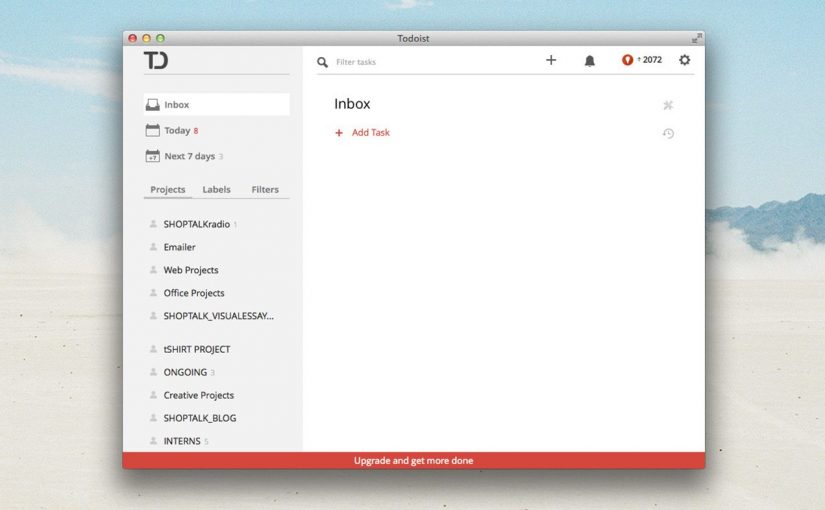
The app system is called Todoist.
It’s a multi-platform and multi-user application so it syncs across. It’s well designed and very robust, even though I only really use the basic features of it. Here are my top five favorite things about the app:
1. If I think of a task for my employees to do while I’m away from the office, I don’t have to remember it, write an email, or wait till I get back to the office to delegate it. I can enter it in through the app on my phone, assign it to whoever it goes to, and it notifies them on their phone or desktop app.
2. You can comment on tasks, so if my employee needs clarification or needs to respond he/she can add a comment to the task and it will notify me. It keeps a track record of this to refer back to.
3. It creates a check-in system. When my employee finishes the task, he/she can check it off and the app notifies me on my phone that the task is complete.
4. It creates task organization. You can create different projects, assign certain people to each project, and delegate tasks below. You can even create sub-tasks under the main task.
5. The stand alone desktop app is simple and easy to use, and I love it. What’s great is I can actually type with a keyboard, and it’s much faster than typing on the phone if I’m in the office.
While mastering the art of delegation is something that I’m still working toward, I have found Todoist to really help me in that process. I still use the written to-do list for my own tasks(Find out why here).
What tools help you delegate?


LET'S CONSPIRE & CREATE
CULTIVATING YOUR VISUAL UNIQUENESS AND STREAMLINING YOUR BRAND'S EVOLUTION

Do you ever struggle with delegation?
I know I do. It seems that this is an ongoing saga for entrepreneurs, especially us who have one of those controlling bones in our body. The drive to do it ourselves, or micro manage is something that I completely struggle with. Sometimes I find myself doing tasks that I don’t need to do, and even that is my own procrastination tool. It takes a conscious effort to be aware of when I’m doing this. To Stop. Then delegate. Better yet. Let go.
I want to share with you one of my new found favorite delegation tools. For those of you who listened to my written to-do list podcast, you’ll already have an idea, but this is a more in-depth description.
The app system is called Todoist.
It’s a multi-platform and multi-user application so it syncs across. It’s well designed and very robust, even though I only really use the basic features of it. Here are my top five favorite things about the app:
1. If I think of a task for my employees to do while I’m away from the office, I don’t have to remember it, write an email, or wait till I get back to the office to delegate it. I can enter it in through the app on my phone, assign it to whoever it goes to, and it notifies them on their phone or desktop app.
2. You can comment on tasks, so if my employee needs clarification or needs to respond he/she can add a comment to the task and it will notify me. It keeps a track record of this to refer back to.
3. It creates a check-in system. When my employee finishes the task, he/she can check it off and the app notifies me on my phone that the task is complete.
4. It creates task organization. You can create different projects, assign certain people to each project, and delegate tasks below. You can even create sub-tasks under the main task.
5. The stand alone desktop app is simple and easy to use, and I love it. What’s great is I can actually type with a keyboard, and it’s much faster than typing on the phone if I’m in the office.
While mastering the art of delegation is something that I’m still working toward, I have found Todoist to really help me in that process. I still use the written to-do list for my own tasks(Find out why here).
What tools help you delegate?
4/07/14
5 Reasons why this tool has helped me with delegation
infuse your vision with a fresh breath of creativity and vitality
BOOK A BRAND PHOTOSHOOT


GET THE DETAILS
GET THE DETAILS
infuse your vision with a fresh breath of creativity and vitality

PODCAST
BRAND INTELLIGENCE
CREATIVE INTELLIGENCE
LIFE INTELLIGENCE


masterfully aligning perception and reality through personal branding



masterfully aligning perception and reality through personal branding


Do you ever struggle with delegation?
I know I do. It seems that this is an ongoing saga for entrepreneurs, especially us who have one of those controlling bones in our body. The drive to do it ourselves, or micro manage is something that I completely struggle with. Sometimes I find myself doing tasks that I don’t need to do, and even that is my own procrastination tool. It takes a conscious effort to be aware of when I’m doing this. To Stop. Then delegate. Better yet. Let go.
I want to share with you one of my new found favorite delegation tools. For those of you who listened to my written to-do list podcast, you’ll already have an idea, but this is a more in-depth description.
The app system is called Todoist.
It’s a multi-platform and multi-user application so it syncs across. It’s well designed and very robust, even though I only really use the basic features of it. Here are my top five favorite things about the app:
1. If I think of a task for my employees to do while I’m away from the office, I don’t have to remember it, write an email, or wait till I get back to the office to delegate it. I can enter it in through the app on my phone, assign it to whoever it goes to, and it notifies them on their phone or desktop app.
2. You can comment on tasks, so if my employee needs clarification or needs to respond he/she can add a comment to the task and it will notify me. It keeps a track record of this to refer back to.
3. It creates a check-in system. When my employee finishes the task, he/she can check it off and the app notifies me on my phone that the task is complete.
4. It creates task organization. You can create different projects, assign certain people to each project, and delegate tasks below. You can even create sub-tasks under the main task.
5. The stand alone desktop app is simple and easy to use, and I love it. What’s great is I can actually type with a keyboard, and it’s much faster than typing on the phone if I’m in the office.
While mastering the art of delegation is something that I’m still working toward, I have found Todoist to really help me in that process. I still use the written to-do list for my own tasks(Find out why here).
What tools help you delegate?
4/07/14
5 Reasons why this tool has helped me with delegation
When you need a trusted creative partner in the room.
Take the Fit Check
Be seen at the level you’re stepping into.

Hey! I'm Nick.
PHOTOGRAPHER
BRAND ALCHEMIST
TEACHER
At vero eos et accusamus et iusto odio dignissimos ducimus qui blanditiis praesentium voluptatum deleniti atque corrupti quos dolores et quas molestias excepturi sint occaecati cupiditate non provident, similique sunt in culpa qui officia deserunt mollitia.
Build authority from the inside out.
Emanate is a creative-direction-led photography experience for entrepreneurs, speakers, and thought leaders in a moment of expansion. This isn’t about better photos. It’s about aligning how you’re seen with who you’ve become. For seasons of rebrand, visibility, and next-level leadership.

Magnetic Authority is a self-guided container for people who feel visible, but not fully anchored.
If your message keeps shifting, your brand feels inconsistent, or your presence doesn’t match your capability yet. This is where you build the foundation before you scale.
Take the Fit Check
Start Here
For founders, creatives, and leaders who want a trusted long-term partner. This isn’t coaching or traditional consulting.
It’s an ongoing creative partnership focused on bringing your personal brand identity to life.
Your brand. Your website. Your visuals.
All shaped as a direct extension of who you are. The work also includes a bespoke process of identifying and aligning the right experts when needed, so nothing gets built out of sync with your core.
Explore the Partnership

Quiet. Precise. Highly Selective.
NEXT post
PREVIOUS post
read the latest
Brand guidelines are static rules for the surface. A Brand Brain is a living codification of identity a team or an AI can generate from. The difference, defined.
We trained six styles of kung fu in one month. Sampling that widely taught me how a creative actually finds the practice worth years: breadth first, the pull as data, then depth.
Travel makes you more creative because unfamiliar places wake up your perception. Why the effect works, and how to bring the sharpened eye home with you.
Your brand photos lag behind you because you kept evolving and the images stayed frozen. Why the gap opens, how to spot it, and what closes it.
The kung fu school had rules: locked-in weekdays, dawn starts, push-ups for lateness. A month inside taught me that constraints you choose are what make depth possible.
A daily creative practice is making one real thing every day, however small, to stay in a proactive state. A working definition, and how to build one that lasts.

AI describes your brand by averaging your public record. How to codify one identity, repeat it everywhere, and get the machines to echo you back accurately.

I’ve photographed Justin Bieber several times and seen fame up close. His stripped-down Coachella set showed the thing I keep relearning about creative work: production amplifies, and only artistry carries.

You recover from creative burnout by treating it as a nervous system state: build real down-cycles, read your own signals, and return to the work you love.

A magnetic personal brand comes from coherence and one clear through-line. Here is how entrepreneurs build one, in order, and the trap that keeps most brands scattered.

I spent a month training kung fu in Wudang at 47, the oldest and slowest learner in the room. What being a beginner again in midlife taught me about pace, comparison, and starting anyway.

You develop taste through thousands of reps of looking closely and deciding what works. A photographer’s honest answer on how taste gets built.

You make a personal brand more coherent by naming the identity underneath it, distilling a one or two word through-line, and bringing the four layers into agreement. The full path, in order.

About the Blogger
I was born in a low middle class conservative religious family in the suburbs of Seattle. Art was and always has been my passion, and more than that a way of life. Starting as a graphic designer, I taught myself photography, built a commercial/editorial business shooting for the worlds biggest brands like Nike, Coca-Cola, Adidas and more. I've also had the opportunity to photograph the world's biggest celebrities like Justin Bieber, Usher, Jessica Alba and more. I've curated a lifestyle around creativity and have learned a lot along the way which I get to share here.
I was born in a low middle class conservative religious family in the suburbs of Seattle. Art was and always has been my passion, and more than that a way of life. Starting as a graphic designer, I taught myself photography, built a commercial/editorial business shooting for the worlds biggest brands like Nike, Coca-Cola, Adidas and more. I've also had the opportunity to photograph the world's biggest celebrities like Justin Bieber, Usher, Jessica Alba and more. I've curated a lifestyle around creativity and have learned a lot along the way which I get to share here.
